Photogrammetry is the science and technology of obtaining reliable information about physical objects and the environment through the process of recording, measuring and interpreting photographic images and patterns of electromagnetic radiant imagery and other phenomena.
Photogrammetry is widely used to generate accurate topographic maps and 3D terrain models by analyzing aerial or drone-captured images. These maps are essential for land development, urban planning, and environmental studies.
Photogrammetry is a clever way of extracting information about the world using photos and images. Explore the topic to learn more about what it is and the various uses for photogrammetry.
What is Photogrammetry? The official photogrammetry definition is “the use of photography in surveying and mapping to ascertain measurements between objects”. Put simply, it’s the science of obtaining measurements from photographs.
Photogrammetry is primarily concerned with making precise measurements of three-dimensional objects and terrain features from two-dimensional photographs.
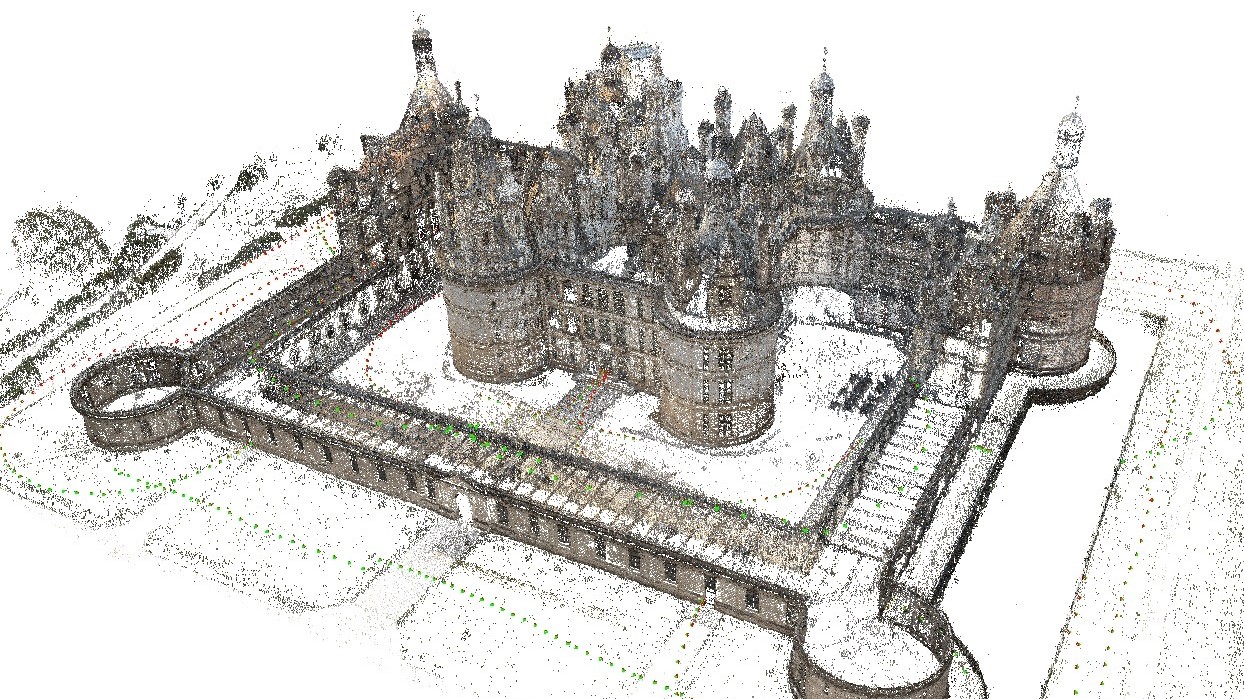
Photogrammetry is the process of turning overlapping 2D photographs into detailed, measurable 3D models. By analyzing how features appear across multiple images, software can calculate depth and geometry, generating a realistic digital reconstruction of the object or environment.
Most photogrammetry software often describe themselves as magic, as they can turn automatically 2D data into 3D. In this page, you will find more technical details on how photogrammetry really works: it's science, not magic after all!
Photogrammetry is the science of making measurements from photographs. The input to photogrammetry is photographs, and the output is typically a map, a drawing, a measurement, or a 3D model of some real-world object or scene.
 Check out our choice of photogrammetry software available right now for virtual reality, gaming, mapping, construction, defense, and so much more!