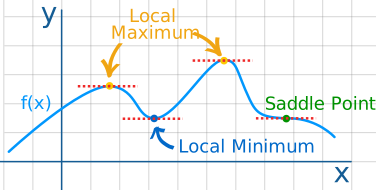
Here is a set of practice problems to accompany the MinimumandMaximum Values section of the Applications of Derivatives chapter of the notes for Paul Dawkins Calculus I course at Lamar University.
The following problems are maximum/minimum optimization problems. They illustrate one of the most important applications of the first derivative. Many students find these problems intimidating because they are "word" problems, and because there does not appear to be a pattern to these problems.
Examine critical points and boundary points to find absolute maximum and minimum values for a function of two variables. One of the most useful applications for derivatives of a function of one variable is the determination of maximum and/or minimum values.
.5 Applied MaximumandMinimumProblems We have used derivatives to find maximums and minimums of functions given by formulas, but it is very unlikely that someone will simply hand you a function a.
The process of finding maximum or minimum values is called optimisation. We are trying to do things like maximise the profit in a company, or minimise the costs, or find the least amount of material to make a particular object.
In this section, we'll use our results on maximaandminima for functions to do word problems which involve finding the largest or smallest value of lengths, areas, volumes, costs, and so on.
In sketching the graph of a function, we spent some time looking for maximumandminimum points, both local and absolute. This idea suggests that we can use the same technique to find that value (or those values) of a variable which maximize or minimize a length, an area, or a profit.
Many application problems in calculus involve functions for which you want to find maximum or minimum values. The restrictions stated or implied for such functions will determine the domain from which you must work.